

In hospital billing, room charges make up a large part of inpatient revenue. When room billing is done correctly, payments move smoothly. When the wrong revenue code is used, claims often get delayed or denied.
Revenue Code 0114 is used for private inpatient rooms, but providers and billing teams frequently misunderstand it.
This guide explains Revenue Code 0114 in clear and simple English, focusing on correct usage, documentation, and reimbursement impact for healthcare providers.
Understanding Revenue Code 0114 in Hospital Billing
Revenue Code 0114 represents charges for a private room provided to an inpatient. It is used only when a patient has been officially admitted and placed in a private room for routine inpatient care.
This code reports the cost of the room itself. It does not include physician services, nursing care, supplies, or procedures. Its purpose is to clearly show payers that the hospital provided private accommodation during an inpatient stay.
Why Providers Must Use Revenue Code 0114 Carefully?
Private room charges are higher than semi-private room charges. Because of this, insurance companies review these claims closely. If this Code is used incorrectly, payers may reduce payment or deny the claim completely.
For providers, correct use of this code helps protect revenue, reduce back-and-forth with payers, and keep billing compliant with insurance rules.
Situations Where Revenue Code 0114 Is Appropriate
This code should only be used when all billing conditions match the inpatient private room criteria. The patient must be admitted as an inpatient, and the assigned room must be private, meaning only one patient occupies the room.
The stay must also be routine inpatient care. Specialty units and temporary room usage do not qualify under this code.
Cases Where Revenue Code 0114 Causes Billing Problems
Many denials happen because Revenue Code 0114 is applied to situations where it does not belong. This includes observation stays, outpatient services, semi-private rooms, and intensive care units.
Using it in these cases creates a mismatch between patient status and billed charges, which payers flag quickly. Hiring professional coders can also strengthen the process, and boost practice revenue.
Difference Between Revenue Code 0114 and Other Room Codes
Revenue Code 0114 is used only for private inpatient rooms, where one patient stays alone in a room. This code reflects higher room charges because the space is not shared. It should be applied only when the patient is officially admitted as an inpatient and placed in a private room.
How Other Room Codes Are Different?
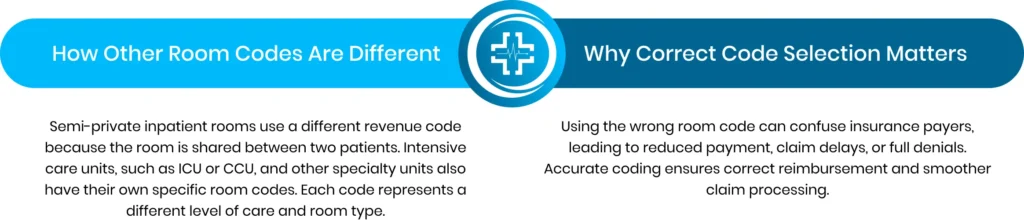
Semi-private inpatient rooms use a different revenue code because the room is shared between two patients. Intensive care units, such as ICU or CCU, and other specialty units also have their own specific room codes. Each code represents a different level of care and room type.
Why Correct Code Selection Matters?
Using the wrong room code can confuse insurance payers, leading to reduced payment, claim delays, or full denials. Accurate coding ensures correct reimbursement and smoother claim processing.
Documentation That Supports Revenue Code 0114 Claims
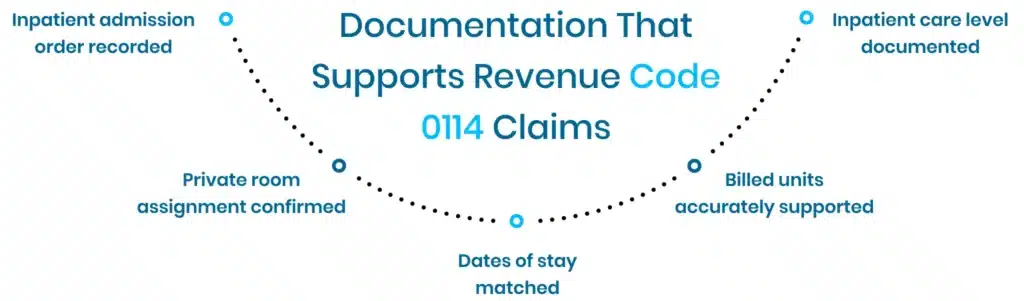
Strong documentation is the backbone of successful billing. For the Code 0114, providers should ensure that inpatient admission orders are clearly recorded. Room assignment records must show that the patient stayed in a private room.
Dates of stay should match the billed units, and medical records should support the inpatient level of care. When documentation is clear, payer reviews become much smoother.
- Inpatient admission order recorded
- Private room assignment confirmed
- Dates of stay matched
- Billed units accurately supported
- Inpatient care level documented
How Payers Review Revenue Code 0114 Claims?
Insurance companies check several details when reviewing private room charges. They confirm inpatient status, room type, length of stay, and whether private accommodation was allowed under the patient’s policy.
If any detail is missing or unclear, the payer may pay only the semi-private rate or deny the private room portion of the claim.
Financial Impact and Claim Accuracy for Revenue Code 0114
Incorrect use of the Code 0114 can have a serious financial impact on hospitals and providers. When this code is billed incorrectly, claims may be denied or delayed, which increases rework and places extra pressure on billing staff.
Over time, repeated mistakes can attract payer audits, leading to repayment requests and possible compliance issues.
Providers can improve claim accuracy by confirming inpatient admission status, verifying that the patient stayed in a private room, and checking payer rules for private room coverage.
Regular staff training, internal claim reviews, and clear documentation practices also help reduce errors, improve clean claim rates, and protect overall revenue.
Final Thoughts
Revenue Code 0114 is designed to report private room charges for inpatient hospital stays. Using it correctly requires proper inpatient status, accurate room assignment, and clear documentation.
For providers and billing teams, understanding this code leads to faster payments, fewer denials, and stronger compliance with payer rules.
Frequently Asked Questions About Revenue Code 0114
What is Revenue Code 0114 used for?
It is used to bill private room charges for patients admitted as inpatients.
Can Revenue Code 0114 be billed for outpatient stays?
No, outpatient and observation stays do not qualify for inpatient private room billing.
Is Revenue Code 0114 valid for ICU rooms?
No, ICU and specialty units use different revenue codes.
What causes most denials for Revenue Code 0114?
Incorrect patient status or billing private rooms as inpatient when criteria are not met.
Do insurers always pay private room charges?
Payment depends on payer rules and whether private rooms are covered or medically justified.