
Anemia is a common condition with two causes, including genetic disorders or chronic disease. Understanding the accurate reason is crucial for accurate Anemia ICD 10 Coding. Wrong code leads to poor documentation, denied claims, and lost revenue.
Therefore, coders should review the clinical documents when coding to ensure appropriate classification of disease. This post covers all you need to know about Anemia ICD 10 coding types and how to maintain accurate documentation for quick reimbursements.
Understanding Anemia ICD 10 Coding Types
Anemia is frequently reported in family practices. In addition, the healthcare experts classify it based on various factors. These include
- Cause
- Severity
- Underlying reason
Healthcare experts classify Anemia under categories ranging from D-50 to D-64. The code is chosen based on the cause, such as nutritional or hereditary. Healthcare experts should mention the accurate reason behind Anemia to ensure accurate coding and quick reimbursement.
ICD-10 Anemia Coding Comparison Table
| ICD-10 Codes | Type of Anemia | Description | Clinical Notes |
| D50.0–D50.9 | Iron deficiency anemia | Iron deficiency-related conditions | Determine if the cause is chronic blood loss, diet-related deficiency, or other documented reason |
| D51.0–D51.9 | Vitamin B12 deficiency anemia | Anemia due to low vitamin B12 levels | Specify the cause, such as an intrinsic factor problem or absorption issues |
| D52.0–D52.9 | Folate deficiency anemia | Folate-related anemia types | Differentiate between poor diet intake and medication-induced deficiency |
| D53.0–D53.9 | Other nutritional anemias | Nutritional anemia not classified elsewhere | Use only when documentation confirms a nutritional cause outside D50–D52 |
| D55–D58 | Hereditary hemolytic anemias | Genetic hemolytic disorders, including thalassemia and sickle cell disease | Clearly document the inherited condition versus other causes |
| D59.0–D59.9 | Acquired hemolytic anemia | Hemolysis due to acquired factors | Identify triggers like autoimmune response, drugs, or infections |
| D60–D61.9 | Aplastic anemia and bone marrow failure | Bone marrow production failure conditions | Mention whether congenital, drug-related, idiopathic, or secondary cause |
| D63.0–D63.8 | Anemia in chronic diseases | Anemia linked with other long-term conditions | Always code underlying disease first when required by guidelines |
| D64.0–D64.9 | Other/unspecified anemia | Unclear or mixed anemia cases | Use only when documentation does not provide a specific classification |
Best Practices for Anemia ICD 10 Coding and Documentation
Accurate evaluation of medical records are cruical for the error-free Anemia ICD 10 Coding. Since Anemia is a common condition and often happens due to other diseases, accurate reporting becomes essential.
Find the Type of Anemia
Medical coders should identify the specific type of Anemia by reviewing the documentation. Assigning the accurate type of disease helps the payer recognize the disease and release the payment for the services given.
Implement Accurate Anemia ICD 10 Coding Rules
After documenting the actual reason, the coders should assign the code reflecting the disease. As we mentioned above, that sometime anemia happens because of another disease. Therefore, the code for that particular disease should be entered for accurate documentation and claim filing.
This focuses on kidney problems, malignancy, and other long-term disorders. Once the correct code is assigned, payers can easily recognize the underlying cause and release the payment.
Use Document to Back Code Selection
Good notes help in clean coding. Coders must always match the code with what the doctor writes. If notes are not clear, then coding may go wrong.
A good record should show:
- Clear cause of anemia
- Related illness if present
- Test reports like blood count
- Doctor’s final finding
When all this is present, Anemia ICD 10 coding becomes easy and correct. It also helps in fast claim approval and fewer errors.
Common Mistakes in Anemia ICD 10 Coding
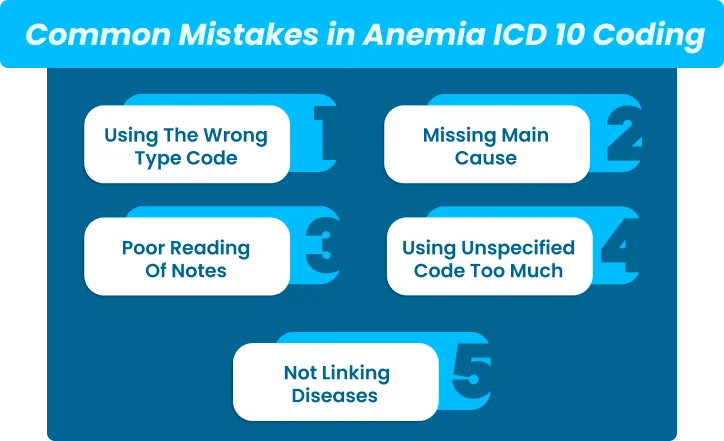
Many coders make small mistakes during the Anemia ICD 10 Coding that later cause big issues in billing. Let’s look at them in simple words.
1. Using the wrong type code
Sometimes coders pick general code instead of exact type. This leads to a claim delay.
2. Missing main cause
If anemia is due to another disease, but that disease is not coded first, the claim may be denied.
3. Poor reading of notes
Skipping details in doctor notes leads to wrong Anemia ICD-10 coding.
4. Using unspecified code too much
D64.9 should be the last option. It should not be used when details are available.
5. Not linking diseases
If anemia is linked with kidney or cancer, both must be shown clearly.
Avoiding these mistakes helps improve clean billing and smooth approval.
Best Tips for Anemia ICD 10 Coding
Here are simple and strong tips for better results:
1. Read the full patient file
Do not rush at all. Read each part of the file with care before you pick any code for anemia case.
2. Find the root cause
Always ask a simple ” why ” question. Try to know what really caused anemia in the body before coding it.
3. Match lab reports
Check the blood test reports carefully. These reports show clear signs that help you pick the right anemia type code.
4. Follow ICD rules
Use ICD rules step by step. Do not skip any rule because each rule guides correct and clean coding work.
5. Double-check work
Look at your code again before you send it. Small check can stop big errors in claim or billing process.
Role of Underlying Disease in Coding
Many anemia cases come from other long-term problems like:
- Kidney disease
- Cancer
- Chronic infections
In such cases, the main disease should be coded first. Then anemia is added.
This rule is very important in Anemia ICD 10 Coding because it shows the full patient condition clearly.
Impact on Revenue Cycle
Good coding helps clinics and hospitals earn faster.
If coding is wrong:
- Claims get delayed
- Payments get stuck
- Workload increases
If Anemia ICD-10 coding is correct:
- Fast payment
- Less rejection
- Clean billing record
So coding is directly linked to revenue flow.
Documentation Tips for Coders
Strong documentation is the basis of correct coding work. It helps coders pick the right code without confusion. When notes are clear, claims move fast, and errors stay low. Good records also support correct Anemia ICD-10 coding and help in clean billing and quick approval from payers.
- The exact diagnosis written by the doctor should be clear so the coder can pick the correct anemia type without confusion or mistake
- The cause of anemia must be clearly noted, such as disease, diet issue, or deficiency, so the correct code can be assigned
- Lab test proof, like blood reports, should support diagnosis and confirm anemia type for accurate and trusted coding work
- The doctor’s notes link must clearly show the final decision so the coder understands the true condition and assigns the right ICD code easily
- Full patient history should be included so past issues are known and coding matches the full health picture properly always
Clear notes make Anemia ICD-10 coding simple and error-free.
Conclusion
Anemia ICD 10 coding is very important in medical billing. It helps in correct patient records, fast claim approval, and smooth hospital work. When coders understand the cause, follow rules, and read documents carefully, errors become low.
Simple steps like checking lab reports, using correct codes, and linking the main disease can improve the full process.
In the end, good coding is not only about rules. It is about care, accuracy, and clear work.
For better results in medical billing and coding support, Paymedics helps improve accuracy and smooth revenue flow with expert guidance and reliable solutions.
Frequently Asked Questions
1. What is Anemia ICD 10 Coding?
Anemia ICD 10 coding is a system used to classify anemia types in medical records for correct billing, reporting, and insurance claim processing.
2. Why is accurate anemia coding important?
It is important because it helps in fast claim approval, reduces errors, and keeps patient records clear and useful for future car
3. What are the main types of anemia codes?
Main types include iron deficiency, vitamin B12 deficiency, folate deficiency, hereditary anemia, and anemia due to chronic diseases or other conditions.
4. What is a common mistake in anemia coding?
A common mistake is using general codes like unspecified anemia when detailed information and cause are already available in medical documents.
5. How does anemia coding affect payment?
Wrong coding can delay or reject claims. Correct coding helps insurance companies process payment quickly and without confusion or extra queries.
6. Who can help in better anemia coding accuracy?
Professional billing and coding support teams like Paymedics can help improve accuracy, reduce errors, and ensure smooth claim processing for providers.